




425 - Assessing Continuity of Care Between Pediatricians and Pediatric Dentists: A Statewide Survey of the Nebraska Chapter of the American Academy of Pediatrics Members
Program Director UNMC College of Dentistry University of Nebraska Medical Center Omaha, Nebraska, United States
Assessing Continuity of Care Between Pediatricians and Pediatric Dentists: A Statewide Survey of the Nebraska Chapter of the American Academy of Pediatrics Members
Wright L, Bilunas A
University of Nebraska Medical Center
Omaha, NE
IRB #0840-25-EX.
Purpose: The purpose of this study is to assess the continuity of care between pediatricians and pediatric dentists in accordance with American Academy of Pediatrics (AAP) and American Academy of Pediatric Dentistry (AAPD) guidelines. The study focuses on coordination and collaboration between pediatricians and pediatric dentists for home care, routine in-office care, and management of restorative and emergent treatment needs.
Methods: A survey was sent out to all members of the Nebraska Chapter of the American Academy of Pediatrics. Participants who are either current residents in a pediatric medical residency program or pediatricians who graduated from an accredited residency program were asked to participate in the survey through an email. The survey was set up through REDCap and data was collected virtually. Surveys were conducted anonymously. Data will be stored in secure locations as mentioned above.
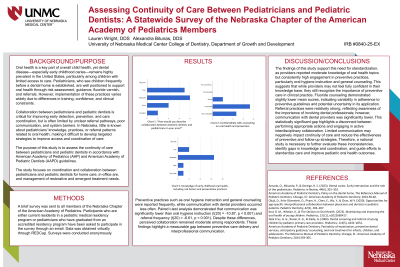
Results: Preventive practices such as oral hygiene instruction and general counseling were reported frequently, while communication with dental providers occurred less often. Paired t-test analysis demonstrated that communication was significantly lower than oral hygiene instruction (t(20) = -10.87, p < 0.001) and referral frequency (t(20) = -6.61, p < 0.001). Despite these differences, perceived collaboration remained moderate among respondents. These findings highlight a measurable gap between preventive care delivery and interprofessional communication.
Discussion/
Conclusion: The findings of this study support this need for standardization, as providers reported moderate knowledge of oral health topics but consistently high engagement in preventive practices, particularly oral hygiene instruction and general counseling. This suggests that while providers may not feel fully confident in their knowledge base, they still recognize the importance of preventive care in clinical practice. Fluoride counseling demonstrated slightly lower mean scores, indicating variability in adherence to preventive guidelines and potential uncertainty in its application. Referral practices were relatively strong, reflecting awareness of the importance of involving dental professionals; however, communication with dental providers was significantly lower. This statistically significant gap highlights a disconnect between performing appropriate actions and engaging in active interdisciplinary collaboration. Limited communication may negatively impact continuity of care and reduce the effectiveness of preventive and follow-up strategies. Therefore, a national study is necessary to further evaluate these inconsistencies, identify gaps in knowledge and coordination, and guide efforts to standardize care and improve pediatric oral health outcomes.