




Rutgers School of Dental Medicine, Newark, NJ Newark, New Jersey, United States
Abstract:
Background: Accurate assessment of root resorption in primary teeth is essential for diagnosis, monitoring, and clinical decision-making in pediatric dentistry. Although artificial intelligence (AI) has been increasingly applied to dental image analysis, its ability to reliably identify root resorption stages in primary teeth has not been well established.
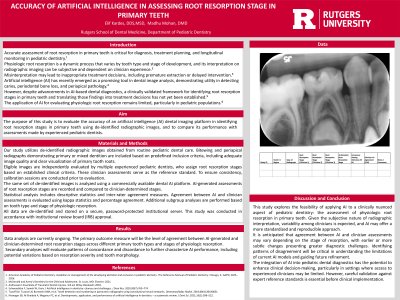
Purpose: The purpose of this study was to evaluate the accuracy of an artificial intelligence (AI) dental imaging platform in identifying root resorption stages in primary teeth using de-identified radiographic images.
Methods: This retrospective study evaluates de-identified radiographic images obtained from routine pediatric dental care. Eligible primary teeth are independently assessed by experienced pediatric dentists to determine root resorption stage, which serves as the reference standard. The same de-identified images are analyzed using a commercially available dental AI platform. Agreement between AI- and clinician-assigned root resorption stages is assessed using descriptive statistics and inter-rater agreement measures.
Results: The primary outcome measure is the level of agreement between AI-generated and clinician-determined root resorption stages across different primary tooth types and stages of physiologic resorption. Secondary analyses will assess patterns of concordance and discordance to characterize AI performance across resorption severity.
Conclusions: This study will assess the feasibility and diagnostic accuracy of AI-assisted identification of root resorption stages in primary teeth. The findings may inform future development of clinically validated AI-based tools to support objective assessment and monitoring in pediatric dentistry.