395 - Effects Of Variation In RUNX2 Tandem Repeats On Jaw Development
Saturday, May 23, 2026
2:30 PM - 2:45 PM PST
Has Audio
Abstract
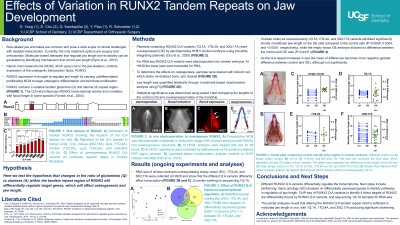
Purpose: The transcription factor Runx2 is essential for bone formation. One highly variable domain in RUNX2 is a glutamine:alanine (Q:A) tandem repeat motif that may affect its transcriptional activity on target genes, and differences in Q:A ratio correlates with facial length in some evolutionary clades. We hypothesize that altering Q:A will differentially regulate target genes and alter jaw length.
Methods: Three Q:A variants (1Q:1A, 17Q:4A, 30Q:17A) and empty vector were overexpressed in chicken embryos by electroporating into neural crest cells that give rise to the jaw skeleton. Lower jaws and heads were collected for RNA-seq and morphometric analysis. Alizarin red was used to stain mineralized bone, and jaw length was quantified using landmark-based morphometric analysis. Results: Embryos overexpressing 1Q:1A (n=18), 17Q:4A (n=10), and 30Q:17A (n=23) developed significantly shorter mandibles on the electroporated side than the contralateral side (p=0.0008, p=0.0034, and p<0.0001, respectively), whereas empty vector controls (n=14) were not significantly different (p=0.4431). As Q:A repeat size increased, the mean difference between control and electroporated sides became slightly more negative, indicating greater mandibular shortening, although not significantly. Empty vector, 17Q:4A, and 30Q:17A RNA-seq samples showed both shared and distinct differentially expressed target genes. Sequencing of 1Q:1A is ongoing.
Conclusions: Different RUNX2 Q:A variants differentially regulate the transcriptome. Q:A variants 1Q:1A, 17Q:4A, and 30Q:17A each produced significant mandibular shortening, supporting a role for RUNX2 Q:A variation in regulating jaw development. Next steps include gene ontology, ChIP-seq, and completion of RNA-seq for 1Q:1A samples.
Identify Supporting Agency and Grant Number: Research supported by NIH Grants R01 DE016402 and S10 OD021664 to RAS, and the UCSF Dental Student Research Fellowship Program.

.jpg)