

Mott Children's Health Center Flint, Michigan, United States
Abstract:
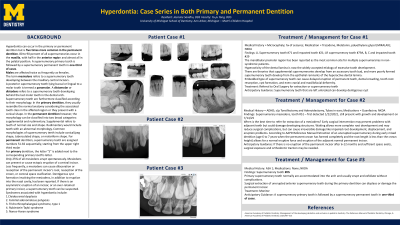
Purpose: The purpose of this case series is to illustrate implications and management of hyperdontia in primary and permanent dentition.
Methods: Three patient cases seen at C.S. Mott Children’s Hospital Ann Arbor and Mott Children Health Center Flint.
Supernumerary teeth are five times more common in the permanent dentition. The mandibular premolar region has been reported as the most common site for multiple supernumeraries in non-syndromic patients. Case #1 exhibits three full bony impacted supernumerary teeth in the premolar region of the lower right quadrant and one full boney impacted supernumerary teeth in the premolar region of the lower left quadrant. 80 to 90 percent of all supernumeraries occur in the maxilla, with half in the anterior region and almost all in the palatal position. Only 25% of all mesiodens erupt spontaneously and can prevent or cause ectopic eruption of a central incisor. Case #2 illustrates this with a mesioden preventing the eruption of tooth #8. Primary supernumerary teeth are normally accommodated into the arch and usually erupt and exfoliate without complications. This is shown in Case #3 of a supernumerary primary later incisor that was accommodated into the dental arch with no complications.
Results: The two cases that present with hyperdontia in the permanent dentition were referred to oral surgery while the case with hyperdontia in the primary dentition is being monitored.
Conclusions: Management and complications differ for hyperdontia present in permanent versus primary dentition.