Program Director NYU Langone Columbia, Missouri, United States
Abstract:
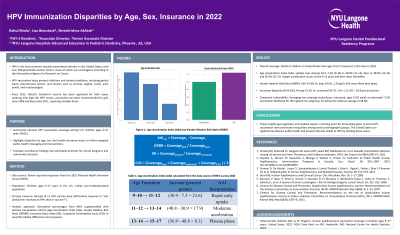
Purpose: This study re‑analyzes nationally representative data from the 2022 National Health Interview Survey (NHIS) to evaluate disparities in Human Papilloma Virus (HPV) vaccination among U.S. children ages between 9 and 17 years. The work applies derived comparative metrics including relative risk ratios, acceleration indices, and composite vulnerability scoring to generate new insights into age, gender, and insurance based differences in vaccine uptake.
Methods: Parent reported HPV vaccination data from the NCHS were examined using derived analytical measures. These included an Age Acceleration Index (AAI) to quantify changes in vaccination uptake across age transitions, a Gender Relative Risk Ratio (GRRR), an Insurance Ratio Index (IRI), and a Composite Vulnerability Score (CVS) integrating multiple demographic risk factors. All calculations were based on publicly reported NCHS percentages.
Results: HPV vaccination coverage increased with age but showed diminishing acceleration after early adolescence. Girls were 24% more likely to be vaccinated than boys (GRRR = 1.24). Privately insured children were twice as likely to be vaccinated as uninsured children (IRI = 2.00). The composite vulnerability scale identified young, uninsured boys as the lowest coverage subgroup, with an estimated vaccination likelihood of approx. 21%, far below the national average.
Conclusions: The report draws attention to differences in vaccination rates and emphasizes the significance of focused public health initiatives to increase HPV vaccine coverage among marginalized, underserved populations.

.jpg)